Riddle:
If it is 1,800 kilometers to America, 1,200 kilometers to Japan, 2,400 kilometers to New Zealand, and 1,400 kilometers to Brazil-
How far is Morocco?
Answer: The answer is 1,700 kilometers, as vowels in the countries' names are worth 300 kilometers and the consonats are worth 200 kilometers.
Riddle:
Marco and Bob have been the best friends ever since they were little kids. They are also very competitive. Throughout the years they have challenged each other to do both physical and mental challenges. And they completed the challenge. But one day Marco thought of something to challenge Bob to do - something he could start but never finish. The average man could do it and so could Mark and they were both the same sex and the same size. It is a physical challenge. Can you figure out what it was?
Answer: Marco challenged Bob to get a tan, but he couldn't...Bob is an albino.
Riddle:
You have two container, a 5 gallon and a 3 gallon container. How do you measure out 4 gallons?
Answer: Fill up the 3 gallon container and pour the 3 gallons into the 5 gallon container.Then, fill the 3 gallon container back up, and pour it into the 5 gallon container.The 3 gallon container will have 1 gallon left. Empty the 5 gallon container.Pour the remining 1 gallon into the 5 gallon container.Then fill the 3 gallon container back up and pour it into the 5 gallon container.Thus, you have 4 gallons.
Riddle:
Hickory-Dickory-Dock! The mouse ran up the clock. The clock struck one and down did come. Hickory-Dickory-Dock!
What am I?
Answer: A guillotine.
Riddle:
It's always 1 to 6, it's always 15 to 20, it's always 5, but it's never 21, unless it's flying.
What is it?
Answer: The answer is: a dice. An explanation: "It's always 1 to 6": the numbers on the faces of the dice, "it's always 15 to 20": the sum of the exposed faces when the dice comes to rest after being thrown, "it's always 5": the number of exposed faces when the dice is at rest, "but it's never 21": the sum of the exposed faces is never 21 when the dice is at rest, "unless it's flying": the sum of all exposed faces when the dice is flying is 21 (1 + 2 + 3 + 4 + 5 + 6).
Riddle:
A boy leaves home in the morning to go to school. At the moment he leaves the house he looks at the clock in the mirror. The clock has no number indication and for this reason, the boy makes a mistake in interpreting the time (mirror-image). Just assuming the clock must be out of order, the boy cycles to school, where he arrives after twenty minutes. At that moment the clock at school shows a time that is two and a half hours later than the time that the boy saw on the clock at home. What time is it?
Answer: The difference between the real time and the time of the mirror image is two hours and ten minutes (two and a half hours, minus the twenty minutes of cycling). Therefore, the original time on the clock at home that morning could only have been five minutes past seven: The difference between these clocks is exactly 2 hours and ten minutes (note that also five minutes past one can be mirrored in a similar way, but this is not in the morning!). Conclusion: The boy reaches school at five minutes past seven plus twenty minutes of cycling, which is twenty-five minutes past seven!...
Riddle:
An item is made from lead blanks in a lathe shop. Each blank suffices for 1 item. Lead shavings accumulated for making 6 items can be melted and made into a blank. How many items can be made from 36 blanks?
Answer: From 36 blanks there are 36 items made. The lead shavings are enough to make 6 blanks. Which make 6 more items. But don't stop here. The new shavings are good for 1 more item. Total: 43.
Riddle:
Ben walked into a hardware store and asked the price of some items. The salesman said: One costs $1, Eight costs $1, Seventeen cost $2, One hundred four costs $3 and One thousand seventy two costs $4. What was Ben buying?
Answer: Ben was buying home address numbers and they cost $1 per digit.
Riddle:
How can this be true? Have a look at the picture. All the lines are straight, the shapes that make up the top picture are the same as the ones in the bottom picture so where does the gap come from?
Answer: The green triangle has dimensions 2 x 5 and gradient 2 / 5 = 0.4 The red triangle has dimensions 3 x 8 and gradient 3 / 8 = 0.375 Hence the gradient of the green triangle is greater than that of the red triangle.
Riddle:
Carl is trying to find solutions to a geometric puzzle. He has a square plot of land that he needs to reserve 1/4 for himself and divide the remaining 3/4 equally and in a similar shape, among his 4 children. There are two possible solutions. Can you solve the puzzle?
Answer: Solution #1 - Squares
First, Carl divides his as to reserve to himself one-fourth in the form of a square.
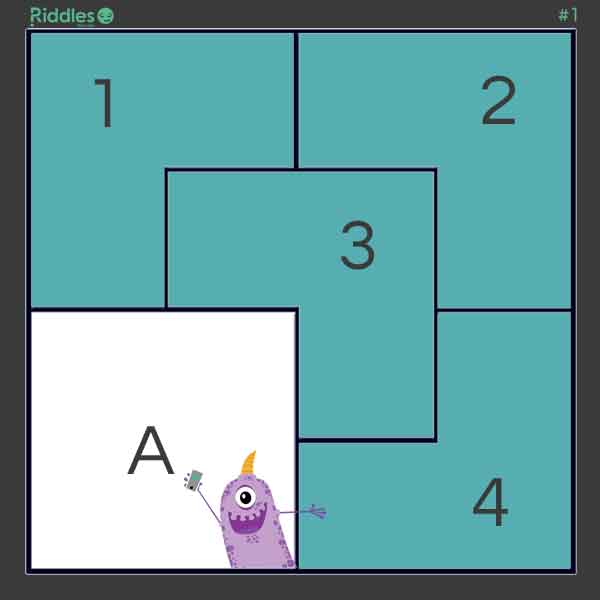
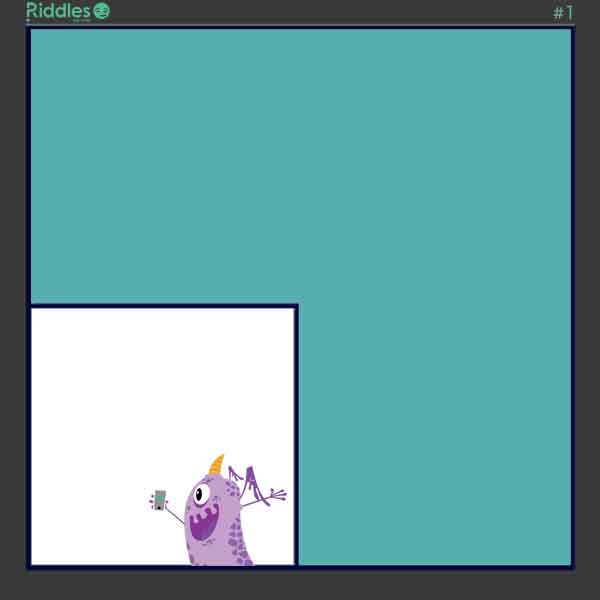 Then, Carl takes the remaining 3/4 shape and scales it down by 1/4. He then, multiplies the shape into 4 identically shaped pieces, and aranges them so that they fit into the original 3/4 shape.
 Solution #2 - Rectangles
First, create a triangle that is 1/4 the size of the square.
Solution #2 - Rectangles
First, create a triangle that is 1/4 the size of the square.
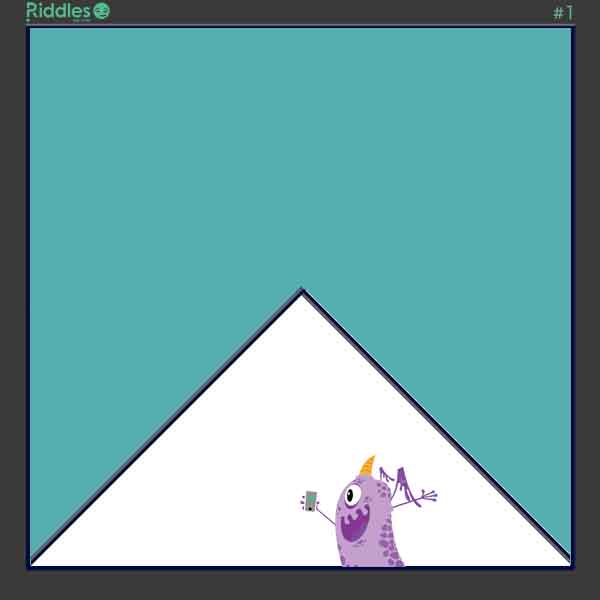 Now, with straight lines, create two squares.
Proceed to disect the two squares with horizontal lines creating 4 triangles.
Then, disect one of the resultuing triangles from each square. The shape of land for each of his four children is divided evenly and is the same shape.
Now, with straight lines, create two squares.
Proceed to disect the two squares with horizontal lines creating 4 triangles.
Then, disect one of the resultuing triangles from each square. The shape of land for each of his four children is divided evenly and is the same shape.
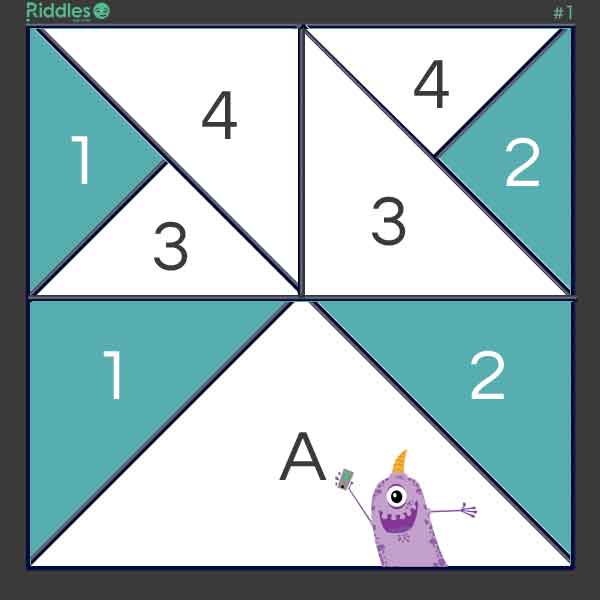
Then, Carl takes the remaining 3/4 shape and scales it down by 1/4. He then, multiplies the shape into 4 identically shaped pieces, and aranges them so that they fit into the original 3/4 shape.
Solution #2 - Rectangles
First, create a triangle that is 1/4 the size of the square.
Now, with straight lines, create two squares.
Proceed to disect the two squares with horizontal lines creating 4 triangles.
Then, disect one of the resultuing triangles from each square. The shape of land for each of his four children is divided evenly and is the same shape.
Riddle:
Two travelers spend from 12 o'clock to 6 o'clock walking along a level road, up a hill, and back again. Their pace is 4 mph on the level, 3 mph uphill, and 6 mph downhill.
How far do they walk and at what time do they reach the top of the hill?
Answer: 24 miles half past three.
Riddle:
What number, when added separately, to 100 and 164 can make each a perfect square?
Answer: The answer is 125. 125+100=225 and 125+164=289. The square root of 225 is 15 and the square root of 289 is 17.
Riddle:
Robert and David were preparing to have a water balloon fight. "No Fair" cried Robert, "You have 3 times as many as I do!" David said "Fine!" and gave Robert 10 more balloons. "Still not fair!" argued Robert, "You still have twice as many as I do." How many more balloons must David give Robert for them to have the same number?
Answer: David must give Robert another 20 water balloons, giving them each 60. Robert started with 30 water balloons and David with 90.
Riddle:
A car's odometer shows 72927 miles, a palindromic number. What are the minimum miles you would need to travel to form another?
Answer: 110 miles. (73037)
Riddle:
Jack has 8 bricks, 7 of them weigh the same but one is slightly heavier. Using a balance scale, how can Jack find the heavier brick in two weighings?
Answer: First, he splits them into piles of 3, 3, and 2 bricks.
Then, he weighs both groups of 3 with each other. If they balance he knows the brick is one of the 2 unweighed bricks and he can weigh them to find the heavier one.
If the stacks of 3 bricks do not balance, he will weigh 2 of the 3 bricks.
If they balance he will know the brick left unweighed is heavier, or if they do not balance, he will find the heavier one.
Riddle:
There is a man stood on top of a mountain frozen holding a peice of straw. How did he get there?
Answer: He was with his friend in a hotair balloon when they were about to hit a mountin so they took of there clothes to make it lighter so they would go higher but it wasnt working so they drew straws and who ever had the shortest straw would have to jump out so he was the one who picked the shortest straw.
Riddle:
My first is often at the front door. My second is found in the cereal family. My third is what most people want. My whole is one of the United States. What am I?
Answer: MATRIMONY (mat rye money). Which is certainly a "united state"!
Riddle:
My first is high, My second damp, My whole a tie, A writer's cramp. What am I?
Answer: Hyphen. The first two lines yield high-fen. A hyphen is used by a writer to tie (or cramp) two words together.
Riddle:
Three working women have different careers. If only one of statements 1, 2 and 3 are true, can you tell whether or not Mary is a nurse? 1. This statement is only true if statement 5 is false. 2. This statement is true if statements 4 or 5, or both 4 and 5 are true. 3. This statement is false only if both statements 6 and 1 are true. 4. Mary is a nurse 5. Karen is an artist. 6. Sarah is a photographer.
Answer: Mary is not a nurse. The way to solve this riddle is to consider statements 4, 5, and 6 and create a chart of all possible true and false answers. Next, fill in the chart according to statements 1 through 3. You will discover that there is only one line where only one of the statements one, two, and three are true. Thus, it is determined that: Statements 4 and 5 are false and statement 6 is true.
Riddle:
Five baby boomer couples each have one child. Each child is a different age than any of the other children. Each child has a favorite toy which is different from any of the other children's favorite toys. Each family eats at only one fast food restaurant. No two women have the same name and no two men have the same name. The children's names are not known. The child who plays with trains is the youngest. Bill's child plays with a GI Joe. Julie's child likes Pokeman. Mike's family eats at Taco Bell. The family of the 4 year old likes Kentucky Fried Chicken. The oldest child is four years older than Marie's child. The child who plays with Barbie is 8 years old. The child with the age is in the middle, has a mother named Marie. The child in the family that eats at McDonalds has a two year age difference with Larry's child. Carol is the mother in the family that eats at Dairy Queen. The child that plays Nintendo likes Burger King. Steve's child is two years apart in age from the child of the family that eats at Kentucky Fried Chicken. The child that plays with trains is two years apart from the 6 year old. The child that eats at McDonalds is two years older or younger than Regina's child. Lisa's child is 10. Who is married to George?
Answer: Lisa is married to George, and their 10 year old plays with Nintendo. They like to eat at Burger King. The associations are: Child age 4, mother Regina, Father Larry, trains, KFC Child age 6, mother Julie, Father Steve, Pokeman, McDonalds Child age 8, mother Marie, Father Mike, Barbie, Taco Bell Child age 10, mother Lisa, Father George, Nintendo, Burger King Child age 12, mother Carol, Father Bill, GI Joe, Dairy Queen To solve, draw a grid with five rows and five columns. Across the top, above the columns, write Age, Mother, Father, Toy and Food. Figure out the known ages and write them in order in the first column. One child's age is unknown at first. However, once the youngest child is discovered (the one who plays with trains) it is then known that the oldest child is the child with the unknown age. Through additional clues, it is possible to determine that the oldest child is age 12. Take the clue, Lisa?s child is 10. In the mother column corresponding to the age 10, you would write LISA (Maybe circle it, because it is the correct answer.) In the mother column for every other age, write "not Lisa". Do this for each clue. If you know the answer because of a clue, write it in the appropriate column, and then be sure to write "not such and such" in all the other rows for that clue. For example, "The youngest child plays with trains", would result in "not trains" for any child you can tell isn?t the youngest, but you can?t write "trains" for any child, because you don?t know which child is the youngest at first. Eventually, you may find that "mother not Marie" is on every line except one, and then you would know that Marie is the mother on the empty line.

